What I built
I designed and built Tarazu’s scoring, evidence and decision-record workflows.
The Relay demo follows a fictional team with one engineer and two weeks. Approval requests are delayed. Should the team build reminders, add a status dashboard, or test a readiness checklist?
Follow the Relay decision
-
Check the case for reminders. The initial assumption is that people overlook complete approval requests. The demo shows that assumption beside the reminder option and the inputs used to score it.
-
Compare the evidence. Fictional administrator notes support reminders, while approvers describe missing information. In the prepared example, four of five reviewed requests were waiting for documents. Those records challenge the original explanation; they do not establish how common either problem is.
-
Choose the next test. The team proposes trying a paper readiness checklist with five requesters before committing engineering time. Reminders remain an option for complete requests that are overlooked. The decision is saved as a draft, with its reasoning and unknowns.
-
Review the saved decision. The record includes the problem, the choice, evidence for and against it, and the next test. Users can compare the two demo decision rounds to see what changed and why.
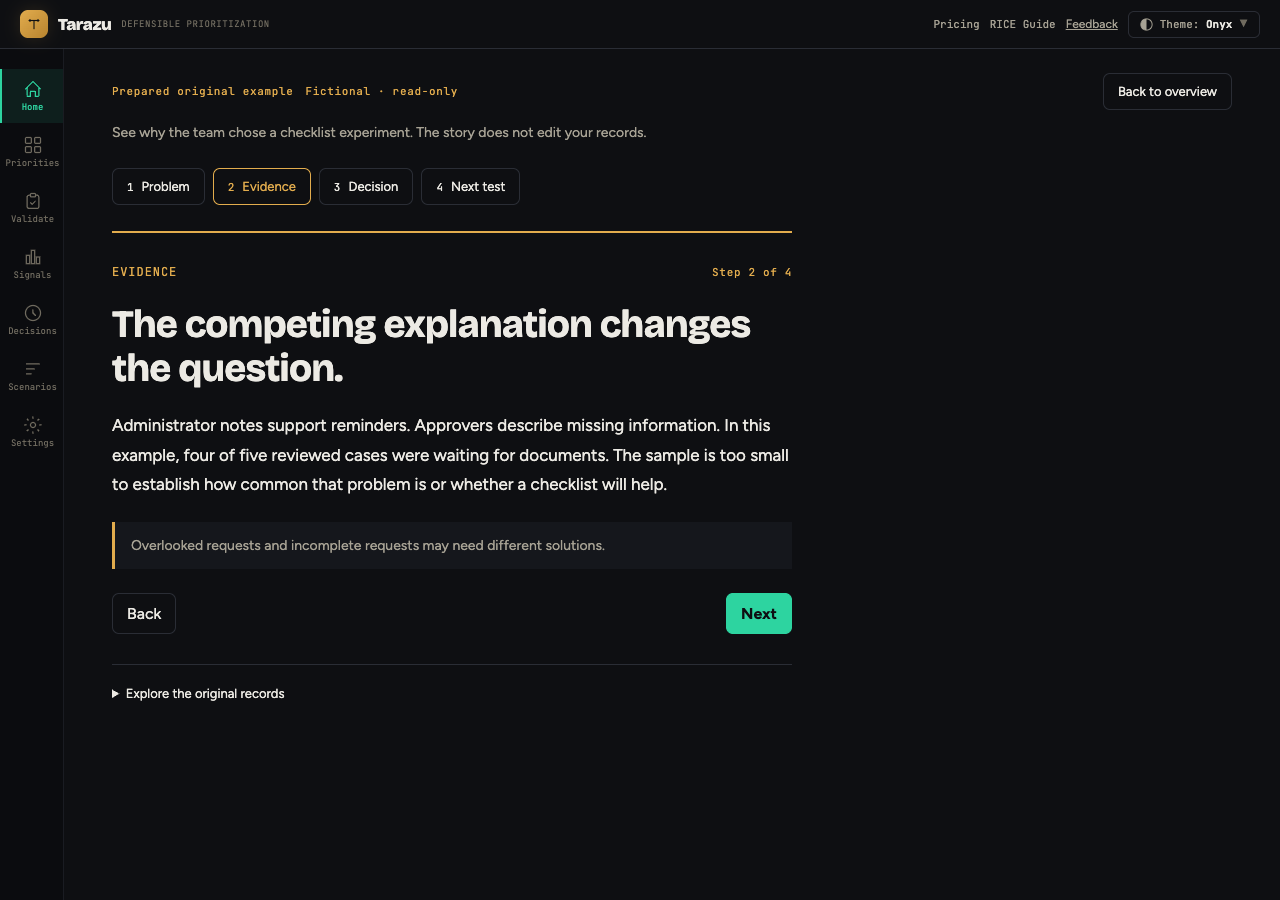
Current Relay demo, captured October 24, 2026. The research records and planning figures are fictional. Open the full-size screenshot.
Keep scores with their assumptions
Tarazu uses 1–100 bands for all four RICE inputs: reach, impact, confidence and effort. The priority index is reach × impact × confidence ÷ effort. The inputs are relative planning scores, not measured returns or calibrated probabilities.
Copy a decision brief
Copy decision brief copies the problem, choice, reasoning, evidence and next test as Markdown. If clipboard access is blocked, the app shows selectable text to copy manually.
Users can record an outcome and choose whether to keep, revise or retire the decision. Earlier reasoning remains available alongside later reviews.
Guest work and optional AI
Users can explore the fictional demo and work locally in their browser without an account. Cloud saving, live AI analysis and score suggestions require sign-in.
An AI request sends the supplied workspace context, including linked evidence, to Tarazu and Anthropic. Users review the proposed scores and recommendations; the calculation and saved decision remain available for inspection.
Demo scope
Relay demonstrates the workflow using synthetic research, assumptions and draft decisions. The paper-checklist test has not been run. Whether the workflow helps teams make and review better decisions needs evaluation in real use.